The Quick Answer:
Bovine collagen is made from cows, specifically extracted from hides (skin), bones, and connective tissues. Through a process called hydrolysis, these animal parts are broken down into collagen peptides that your body can absorb. In the UK and EU, bovine collagen typically comes from grass-fed cattle raised under strict farming standards to ensure quality and safety.
Introduction
If you’re considering a bovine collagen supplement, you’ve probably wondered exactly what goes into those capsules or powder tubs. The answer might surprise you – bovine collagen comes from parts of the cow that would otherwise go to waste in the meat production process.
Understanding what bovine collagen is made from helps you make informed choices about quality, sourcing, and whether a particular supplement aligns with your values. This guide explains the manufacturing process, sourcing standards, and what to look for when choosing a quality product.
The Primary Sources of Bovine Collagen
Bovine collagen supplements are extracted from three main parts of the cow, the skin, the bones, and cartilage.
Cow Hides (Skin)
The most common source for bovine collagen supplements is cow hide. The skin contains high concentrations of Type I and Type III collagen, making it ideal for supplement production.
Hides are typically considered the cleanest source because skin regenerates throughout the animal’s life. This constant renewal means the tissue is relatively fresh and contains fewer accumulated impurities compared to bone or cartilage.
Most premium bovine collagen products, particularly those from European manufacturers, use hide-derived collagen exclusively.
Bones
Cow bones are another rich source of collagen, particularly Type I collagen. Bones from grass-fed cattle contain collagen along with minerals like calcium and phosphorus.
Bone-derived collagen requires more extensive processing to separate the collagen from mineral components.
The resulting product can be high quality, but the extraction process is more complex than hide-derived collagen.
Connective Tissue and Cartilage
Some bovine collagen supplements use connective tissues and cartilage, which contain Type II collagen alongside Types I and III. Type II collagen is particularly beneficial for joint health.
However, most general-purpose bovine collagen supplements focus on hides and bones, as these provide the Type I and Type III collagen most people seek for skin, gut, and overall health benefits.
If all of this talk of bones, skin, and cartilage makes you a bit uneasy, just remember – these are all parts of the animal our ancestors would have made use of for millennia.
In Ancient Egypt, there’s evidence that offal and cuts of meat we would consider ‘strange’ today were highly prized, and often preferred over muscle meat. Perhaps they knew where the goodness was.
The Manufacturing Process: From Cow to Capsule
Understanding how bovine collagen is made helps you appreciate why quality varies between products.
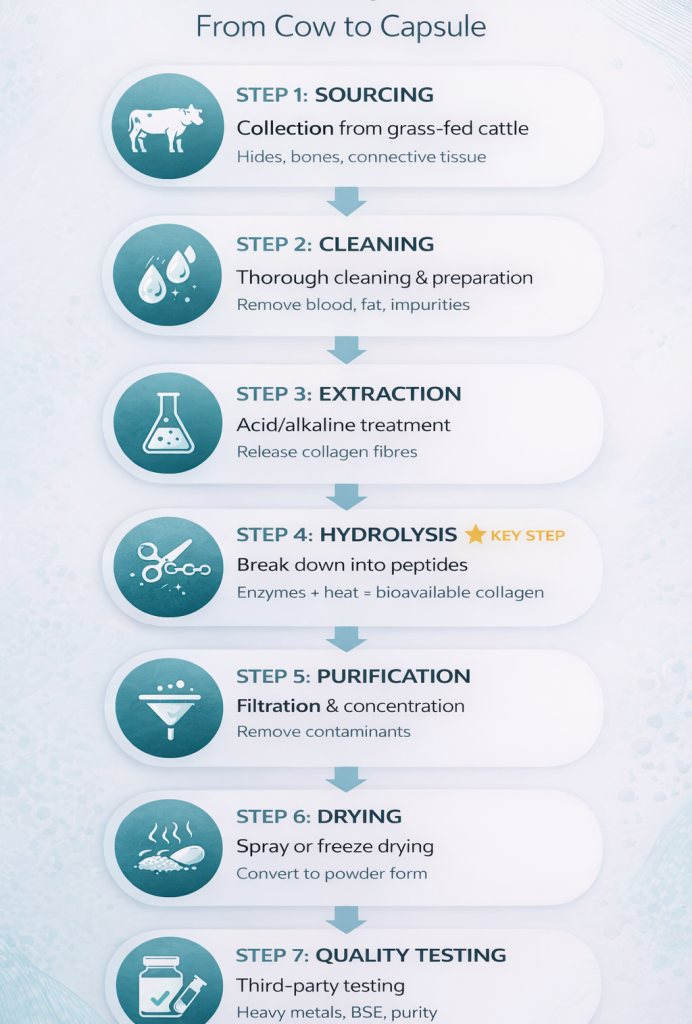
Step 1: Sourcing and Collection
After cattle are processed for meat, the hides, bones, and connective tissues are collected. Reputable manufacturers source from specific farms or regions known for high animal welfare standards.
In the UK and EU, this means sourcing from farms that meet strict regulations on animal health, feeding practices, and welfare standards.
Step 2: Cleaning and Preparation
The raw materials undergo thorough cleaning to remove any blood, fat, or other tissues. This step is crucial for producing a pure final product.
Hides are typically soaked and washed multiple times. Bones may be degreased to remove marrow and fat content.
Step 3: Extraction
The cleaned materials are then treated to extract the collagen.
This typically involves soaking in an acid or alkaline solution to break down the tissue structure and release collagen fibres. The specific pH and temperature are carefully controlled to preserve collagen integrity whilst breaking down surrounding materials.
Different manufacturers use slightly different extraction methods, which can affect the final product’s amino acid profile and molecular weight.
Step 4: Hydrolysis
This is the most important step in creating a supplement your body can actually use.
Native collagen molecules are too large for your digestive system to absorb effectively. Hydrolysis breaks these large molecules into smaller peptides (also called hydrolysed collagen or collagen peptides).
The process uses enzymes or further acid/alkaline treatment, combined with heat, to ‘cleave’ the long collagen chains into shorter segments. The degree of hydrolysis determines the final molecular weight of the peptides.
Smaller peptides (lower molecular weight) are generally easier for your body to absorb, though the optimal size remains a topic of ongoing research.
Step 5: Purification and Concentration
After hydrolysis, the collagen solution is filtered and purified to remove any remaining impurities. This creates a concentrated collagen peptide solution.
The purification process typically includes multiple filtration stages to ensure the final product meets quality standards for heavy metals, bacteria, and other potential contaminants.
Step 6: Drying
The concentrated liquid collagen is dried into powder form through spray drying or freeze drying.
Spray drying involves atomising the liquid into fine droplets and exposing them to hot air, rapidly evaporating the water and leaving behind powder particles. This is the most common method and is cost-effective whilst preserving collagen quality.
Freeze drying, or lyophilisation, removes water by freezing the liquid and then reducing pressure to allow the ice to sublimate directly to vapour. This method is more expensive but can preserve more of the collagen’s natural structure. However, for hydrolysed collagen peptides, spray drying is generally adequate and more economical.
Step 7: Quality Testing
Reputable manufacturers test the final product for:
- Protein content and amino acid profile
- Molecular weight distribution
- Heavy metal contamination
- Microbiological safety
Products meeting safety and quality standards are then packaged into capsules, tablets, or powder containers for retail sale.
UK and EU Sourcing Standards
Where your bovine collagen comes from matters significantly for both quality and safety.
Grass-Fed vs Conventional
Many premium bovine collagen products emphasise grass-fed sourcing. Grass-fed cattle are raised primarily on pasture rather than grain-based feedlot systems.
Potential benefits of grass-fed sourcing include higher animal welfare standards, as grass-fed cattle typically have more natural living conditions, as well as potentially better amino acid profiles, though differences are generally small. Lower exposure to antibiotics and growth hormones, which are more common in intensive farming systems.
However, well-managed conventional farming in the UK and EU also maintains high standards. The key is choosing products from reputable manufacturers with transparent sourcing.
Geographic Origin
Common sources for bovine collagen include:
- UK and Ireland: High welfare standards, extensive grassland farming, strong regulatory oversight.
- Continental Europe (France, Germany, Switzerland): Similar high standards to the UK, often from Alpine or other traditional cattle regions.
- South America (Brazil, Argentina): Large-scale cattle farming, generally grass-fed due to climate and geography, but quality varies by manufacturer.
- North America (USA, Canada): Mix of grass-fed and grain-fed systems, good regulatory oversight but less stringent than EU in some areas.
For UK consumers, choosing European-sourced bovine collagen offers the benefit of strict regulatory standards you can trust.
Quality Indicators: What to Look For
Not all bovine collagen supplements are created equal. Here’s what separates premium products from lower-quality alternatives.
1. Hydrolysed vs Native Collagen
Always choose hydrolysed collagen (also called collagen peptides or collagen hydrolysate) for supplements.
The hydrolysis process makes the collagen bioavailable – meaning your body can actually absorb and use it.
Native or undenatured collagen has specific applications (particularly Type II for joints), but for general health benefits, hydrolysed collagen is superior.
2. Molecular Weight
Lower molecular weight peptides are generally better absorbed. Look for products specifying their molecular weight distribution, typically measured in Daltons (Da). Daltons are a scientific way to measure molecules of very small mass, or low molecular weight.
High-quality hydrolysed collagen usually has peptides ranging from 2,000 to 5,000 Daltons (Da).
Some manufacturers produce even smaller peptides (under 2,000 Da) marketed as having superior absorption, though the practical difference remains debatable. The bottom line is, look out for Daltons on the bottle.
3. Protein Content
This is simple but critical. Always check the protein content per serving. Pure collagen peptide powder should be at least 90% protein by weight.
If protein content is significantly lower, the product likely contains fillers or other ingredients that dilute the collagen content.
4. Source Transparency
Reputable brands clearly state where their collagen comes from. Look for specific information like “grass-fed cattle from EU farms” or “sourced from pasture-raised cows in Ireland.”
Vague descriptions like “bovine collagen” without geographic or sourcing details may indicate lower-quality raw materials.
5. Third-Party Testing
Quality manufacturers have their products tested by independent laboratories for:
- Heavy metals (lead, mercury, cadmium, arsenic).
- Microbiological safety (bacteria, yeast, mould).
- Protein content verification.
Look for products that provide certificates of analysis or mention third-party testing on their labels or websites.
6. Minimal Additives
The ingredient list should be short. Pure bovine collagen powder contains just one ingredient: bovine collagen peptides (or hydrolysed bovine collagen).
Capsules may include the capsule material itself (typically gelatin or plant-based alternatives), but the collagen inside should still be pure.
Avoid products with numerous fillers, artificial colours, sweeteners (unless specifically designed as a flavoured drink mix), or other unnecessary additives.
Common Questions About Bovine Collagen Manufacturing
1. Is bovine collagen vegetarian or vegan?
Seems an obvious question, but there are vegan collagen replacement supplements out there and it’s worth clearing up any confusion.
No. Bovine collagen is derived from cows, making it unsuitable for vegetarians and vegans.
There are no plant-based sources of actual collagen, though some supplements provide amino acids and nutrients that support your body’s own collagen production.
2. Does the manufacturing process use chemicals?
Yes, the extraction and hydrolysis process uses acids, alkalis, and enzymes. However, these are thoroughly removed during purification.
The final product is pure collagen peptides with no residual processing chemicals.
Reputable manufacturers follow Good Manufacturing Practice (GMP) standards that ensure chemical residues are below detectable levels.
3. How is bovine collagen different from bone broth?
Bone broth is made by simmering bones, usually beef bones, for extended periods, which extracts some collagen along with minerals and other nutrients. However, the collagen in bone broth is not hydrolysed, making it less bioavailable than collagen peptide supplements.
Bovine collagen supplements provide a concentrated, highly bioavailable form of collagen in convenient powder or capsule form.
4. Can you make bovine collagen at home?
Not really, unless you have a secret laboratory you’re not telling us about!
Whilst you can make bone broth at home (which contains some collagen, and it’s a tasty and rewarding experience), creating hydrolysed collagen peptides requires industrial equipment and specific enzymes or chemical treatments that aren’t practical for home production.
Supplements offer a standardised, convenient way to get therapeutic doses of bioavailable collagen.
The Bottom Line
Bovine collagen is made from cow hides, bones, and connective tissues through a sophisticated extraction and hydrolysis process. Quality products use materials from well-managed cattle farms, undergo rigorous purification, and provide hydrolysed collagen peptides your body can actually absorb.
When choosing a bovine collagen supplement, prioritise products with transparent sourcing (preferably UK or EU grass-fed cattle), third-party testing, high protein content, and minimal additives. These quality indicators ensure you’re getting a safe, effective product.
Understanding what bovine collagen is made from helps you make informed choices and appreciate the difference between premium products and cheaper alternatives. The source and manufacturing process directly impact the quality and effectiveness of your supplement.
Affiliate Disclosure: This article contains affiliate links. If you purchase through our links, we may earn a commission at no extra cost to you. This helps us continue providing comprehensive, unbiased health information for UK consumers. We only recommend products we genuinely believe offer value.
Medical Disclaimer: This content is for informational purposes only and should not replace advice from your GP or healthcare provider. Always consult your doctor before starting new supplements, especially if you have existing health conditions or take medications.

I started this site after spending weeks trying to figure out which collagen actually works. Now I test products, read the studies, and share honest reviews so you can skip the research phase and get straight to results.