
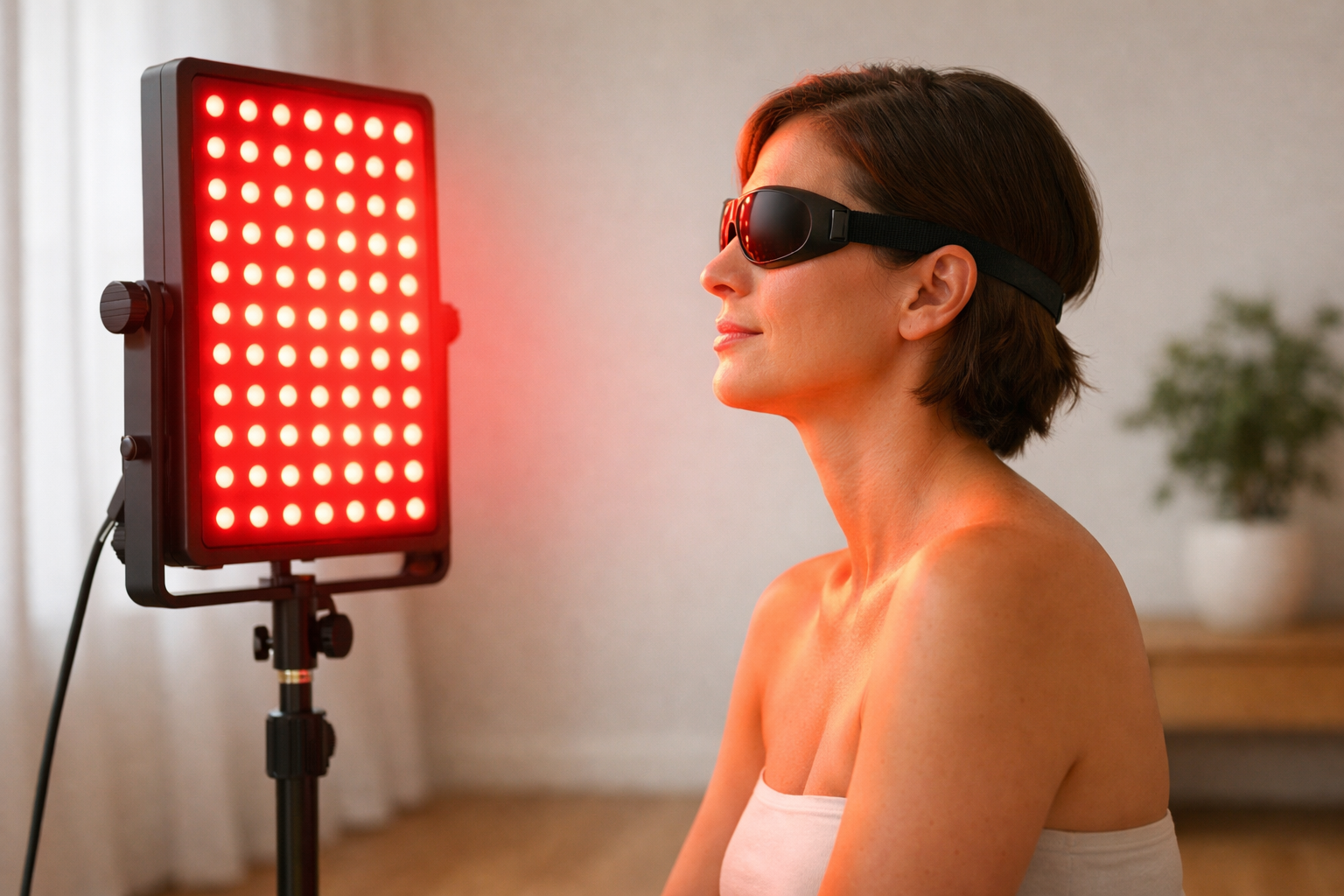
How to Use a Red Light Panel (UK Guide 2026): Distance, Time, and Protocols
Red Light Panel Protocol Essentials
- Distance: 15 to 30cm for skin; 30 to 60cm for muscle or joint depth
- Duration: 10 to 15 minutes for face; 15 to 20 minutes for body areas
- Frequency: 3 to 5 sessions per week for most goals
- Wavelengths: 630 to 660nm (red) for skin; 810 to 850nm (near-infrared) for deeper tissue
- Skin exposure: direct skin contact is essential; clothing blocks the light
- Eye protection: recommended for panels using 850nm near-infrared (goggles included with most UK panels)
- Timing: morning or early evening; avoid within 2 hours of sleep
- Expect visible results between 8 and 12 weeks with consistent use
Or jump to our best red light therapy panels UK roundup
📋 In This Guide
- Quick protocol reference table
- What is a red light panel?
- How does red light therapy work?
- How close should you sit to a red light panel?
- How long should you use a red light panel?
- How to use a red light panel for face and skin
- How to use a red light panel for hair growth
- How to use a red light panel for pain and recovery
- What size red light panel do you need?
- Our recommended red light panel
- When to expect results
- Best practices and common mistakes
- Key takeaways
- FAQs
Quick Protocol Reference Table
Use this as a quick reference for the most common red light therapy goals. Every row represents a starting protocol; individual response varies and you can adjust time or distance based on how your skin and body respond.
← Scroll to see all columns →
| Goal | Distance | Session Length | Frequency | Best Wavelength |
|---|---|---|---|---|
| Face (anti-ageing, collagen) | 15-30cm | 10-15 min | 4-5x per week | 630-660nm red |
| Hair growth (scalp) | 15-30cm | 10-15 min | 3-5x per week | 630-660nm red |
| Muscle or joint pain | 30-60cm | 15-20 min | 4-5x per week | 810-850nm NIR |
| Post-exercise recovery | 30-60cm | 10-15 min | After training | Combined red + NIR |
| Whole body wellness | 50-90cm | 15-20 min | 3-4x per week | Combined red + NIR |
| Mood and energy | 30-60cm | 15-20 min | 4-5x mornings | Combined red + NIR |
| Wound or blemish healing | 15-30cm | 10-15 min | Daily until healed | Combined red + NIR |
Values reflect typical protocols used in clinical studies and manufacturer guidance. Always follow the specific instructions for your panel, as irradiance levels vary considerably between devices.
What Is a Red Light Panel?
A red light panel is a device that emits specific wavelengths of visible red light and, in most modern panels, invisible near-infrared light. Sometimes called red light therapy (RLT) or photobiomodulation (PBM) in clinical settings, the treatment has been used in medicine since the 1960s, originally for wound healing and later for a wide range of skin, muscle, and joint applications.
UK panels vary hugely in size, intensity, and wavelength profile. At one end you have small portable panels sized for face treatment (roughly 15 x 15cm), and at the other end you have half-body and full-body panels that stand as high as 180cm. The best modern panels emit both red wavelengths (typically 630 to 660nm, which target skin-level tissue) and near-infrared wavelengths (typically 810 to 850nm, which penetrate deeper into muscle, joints, and bone). A well-designed dual-wavelength panel covers nearly every red light therapy use case we cover on this site.
A red light panel is not the same as an infrared sauna (which uses heat, not light wavelengths for cellular effects) and not the same as an LED face mask (which is a different form factor but typically uses similar wavelengths for facial use only). We cover the LED face mask category in our best red light therapy masks UK roundup.
How Does Red Light Therapy Work?
Red and near-infrared wavelengths are absorbed by mitochondria, the energy-producing structures inside your cells. Specifically, the wavelengths are absorbed by an enzyme called cytochrome c oxidase, which sits in the mitochondrial electron transport chain. The photons trigger a cascade of downstream effects: increased ATP (cellular energy) production, modulated reactive oxygen species, and signalling changes that promote tissue repair and reduce inflammation.
The practical result depends on which tissues the light reaches. Red wavelengths (630 to 660nm) travel to a depth of around 1 to 2mm, which covers the skin’s full thickness and most of the dermis where collagen and elastin live. Near-infrared wavelengths (810 to 850nm) penetrate 2 to 5cm below the skin, reaching muscle, joint, and shallow bone tissue. This is why combined red plus NIR panels dominate the modern market: you get surface-level skin benefits and deeper tissue effects in the same session.
How Close Should You Sit to a Red Light Panel?
Distance determines irradiance, which is the intensity of the light reaching your skin measured in milliwatts per square centimetre (mW/cm²). Irradiance falls off with the square of distance, so moving from 15cm to 30cm from a panel doesn’t halve the intensity; it quarters it.
As a general rule:
15 to 30cm (6 to 12 inches) is the standard distance for face and skin treatment. This range delivers an irradiance of roughly 50 to 150 mW/cm² on most mid-range UK panels, which is within the therapeutic window for skin applications.
30 to 60cm (12 to 24 inches) is the distance used for deeper tissue treatment including muscles, joints, and post-exercise recovery. This reduces surface intensity but allows near-infrared light to reach more tissue at once.
50 to 90cm (20 to 36 inches) is used for whole-body sessions with larger panels. You cover more surface area but at lower intensity per square centimetre, so session times increase proportionally.
One common mistake is sitting too close in an attempt to speed up results. Irradiance is not dose; dose is irradiance multiplied by time, measured in joules per square centimetre (J/cm²). Most clinical studies use a dose of 5 to 15 J/cm² per session, which is achievable at various distance/time combinations. Going too close for too long can actually push past the therapeutic window into the range where benefits plateau or reverse (the biphasic dose response), so more is not always better.
How Long Should You Use a Red Light Panel?
Session length depends on distance, target tissue, and panel intensity. The core principle is that you’re aiming for a total dose of roughly 5 to 15 J/cm², which at typical UK panel intensities translates to:
Face sessions: 10 to 15 minutes at 15 to 30cm. Longer isn’t better for skin applications; clinical studies typically use 10 to 20 minute sessions, and most anti-ageing and collagen-stimulation research falls in this range.
Body area sessions: 15 to 20 minutes at 30 to 60cm. Muscles and joints benefit from slightly longer exposure because you’re targeting deeper tissue at lower surface intensity.
Whole body sessions: 15 to 20 minutes total, rotating orientation if needed. Larger panels cover more area, so a single session can address multiple goals.
Frequency: 3 to 5 sessions per week is the standard dose across most applications. Daily use is fine but not necessary, and some studies suggest slightly better results with a rest day between sessions than with uninterrupted daily use.
How to Use a Red Light Panel for Face and Skin
Face treatment is the most common use case for red light panels and the one with the strongest direct evidence for visible results. The published research on red light therapy for skin includes controlled studies showing improvements in fine lines, skin tone, elasticity, and collagen density over 8 to 12 week treatment periods.
For face use:
Clean your skin first. Makeup, moisturiser, and SPF will all either block the light or react unpredictably under it. Treat on clean, dry skin, ideally before your evening skincare routine.
Position the panel 15 to 30cm from your face. A desktop stand or counter placement works well. Your eyes should be closed throughout the session, ideally with the goggles your panel manufacturer supplies.
Keep sessions to 10 to 15 minutes. Longer doesn’t deliver better skin outcomes and can move you past the therapeutic dose window. Set a timer and remove yourself from the panel when it ends.
Apply any active skincare after, not before. Vitamin C serums, retinols, and peptide products work well applied after a red light session because freshly treated skin has slightly elevated absorption for a short window.
Aim for 4 to 5 sessions per week. Consistency matters far more than intensity. Three months of steady use gives you the meaningful data point on whether it’s working for your skin.
How to Use a Red Light Panel for Hair Growth
Red light therapy for hair growth (sometimes called low-level laser therapy or LLLT in clinical contexts) has an established evidence base for androgenetic alopecia (male and female pattern hair loss) in particular. The mechanism is thought to involve prolonging the anagen (growth) phase of the hair cycle and improving blood flow to the scalp’s follicles.
For hair use:
Position the panel 15 to 30cm from your scalp. You want the light directed at the area with thinning or recession. This is often easier seated with the panel angled down towards the crown than standing in front of it.
Part your hair to expose the scalp. Hair itself partially blocks the light, so thinning areas benefit most because the scalp is more directly exposed. For thicker hair, sectioning and parting helps light reach the follicles.
Session length is 10 to 15 minutes, 3 to 5 times per week. This matches most clinical trial protocols for hair growth outcomes.
Expect results between 12 and 24 weeks. Hair cycles are slow. Most studies report initial thickening at around 12 weeks and meaningful new growth at 16 to 24 weeks. Before-and-after photographs are the clearest way to track it.
One practical note: if your primary goal is hair growth, a dedicated scalp helmet or cap will give you more consistent coverage than a panel. Panels work but require good positioning discipline.
How to Use a Red Light Panel for Pain and Recovery
This is where near-infrared wavelengths (810 to 850nm) do most of the work. NIR penetrates 2 to 5cm below the skin, reaching muscle tissue, joint capsules, and superficial bone. Published research supports red and near-infrared light for post-exercise recovery, delayed onset muscle soreness (DOMS), joint pain from osteoarthritis, and tendonitis.
For recovery and pain use:
Target the specific area. Unlike whole-body wellness use, pain and recovery applications work best when you target the painful or worked tissue directly. Expose the area fully (clothing blocks NIR just as effectively as red light).
Position 30 to 60cm from the target tissue. This gives you better coverage of larger muscle groups and accepts the slightly lower surface intensity because NIR is the primary working wavelength.
Session length is 15 to 20 minutes. Slightly longer than face sessions because deeper tissue benefits from more total exposure.
Post-exercise use: Either immediately after training or within 2 to 3 hours. Both pre- and post-exercise use have been studied; post-exercise is more consistently shown to aid recovery.
For chronic joint pain: Daily or near-daily use for 4 to 8 weeks, then scale back to maintenance frequency as symptoms improve.
What Size Red Light Panel Do You Need?
Panel size is one of the most common points of confusion for first-time buyers. The right size depends on what you’re trying to treat and how much you want to spend. Here’s the honest framing:
Portable or face-sized panels (roughly 15 x 15cm to 30 x 30cm) are ideal for face and scalp treatment, targeted spot work, and travel. They’re typically £100 to £250. Limitations: slow for whole-body use because you’d need to move between multiple positions.
Mid-size panels (roughly 40 x 20cm to 60 x 30cm) work for face and upper-body treatment from a seated position. These are typically £250 to £500 and suit most home users who want a single panel for multiple use cases.
Half-body panels (roughly 60 x 30cm to 90 x 30cm) cover the torso or lower body in a single session. These are typically £500 to £900 and are the sensible choice if recovery and muscle applications matter to you as much as skin.
Full-body panels (roughly 180 x 30cm or larger) cover head-to-toe in one session. These are typically £900 to £2,500 and represent the commitment end of the market. Fantastic if you’ll use them daily; overkill if face and scalp treatment is your primary use case.
For an in-depth breakdown of our top picks across price tiers, see our best red light therapy panel UK roundup. If you’re looking for a lower-budget entry, our best red light therapy panels under £300 guide covers the sub-£300 category specifically.
Our Recommended Red Light Panel
BlockBlueLight is our top pick across the UK red light therapy market, with a panel range that spans from compact portable units to half-body and full-body towers. The brand invests in proper third-party irradiance testing, pulsing and dimming controls across the range, and a five-year warranty. Below is the PowerPanel, our pick for most home users who want a versatile single-panel solution without going to half-body pricing.

BlockBlueLight PowerPanel
From £399- Combined 660nm red and 850nm near-infrared wavelengths
- Pulsing and dimming controls for protocol flexibility
- Third-party verified irradiance (no inflated claims)
- Suitable for face, scalp, and targeted body areas
- Five-year warranty and UK-based support
- Includes adjustable stand and goggles
When to Expect Results
Red light therapy is a slow-build treatment, not a cosmetic procedure. The cellular mechanisms take weeks to express as visible outcomes, and the published research reflects that. Here’s what to expect for the main use cases:
Skin (fine lines, tone, elasticity): subtle improvements visible between 4 and 8 weeks; meaningful change in tone and texture at 8 to 12 weeks; maximum gains from a treatment cycle at 12 to 16 weeks. Track with photographs taken under consistent lighting, not mirror assessment.
Hair growth: initial thickening at 12 weeks; visible new growth at 16 to 24 weeks. This is the slowest application because hair cycles are long.
Muscle recovery: immediate, session-by-session. Most users notice reduced soreness after 1 to 3 sessions.
Joint pain: cumulative. Most users report meaningful reduction at 4 to 6 weeks of 4-5 sessions per week.
Mood and energy: acute effects (same-day) and cumulative effects at 4 to 8 weeks. The research here is less mature than for skin or muscle.
Best Practices and Common Mistakes
Best Practices
- Treat on clean, bare skin (no lotion, makeup, or SPF)
- Keep sessions within the recommended time window
- Consistency over 8-12 weeks beats any single session
- Use the goggles your panel manufacturer supplies
- Track progress with photographs, not just mirror checks
- Combine with oral collagen for skin-specific goals
- Morning or early evening; avoid within 2 hours of sleep
- Reassess distance and time if results stall
Common Mistakes
- Sitting too close in an attempt to speed up results
- Treating through clothing (clothing blocks the light)
- Irregular use, then expecting results in 2-3 weeks
- Using a panel rated for face only on whole-body needs
- Buying on price alone without checking irradiance specs
- Skipping eye protection on NIR-enabled panels
- Moisturising immediately before treatment
- Using close to bedtime (the red light can disrupt sleep less than blue, but still best avoided right before sleep)
Key Takeaways
A red light panel is one of the most versatile wellness devices you can buy, provided you use it correctly. The core principles are simple: sit 15 to 30cm from the panel for face and skin work, 30 to 60cm for muscle and joint depth, 10 to 20 minutes per session depending on target, and 3 to 5 sessions per week. Consistency over 8 to 12 weeks is where results come from, not single-session intensity.
For most UK buyers, a mid-size combined red and near-infrared panel covers nearly every use case. Spend more on larger panels if whole-body recovery or pain management is your primary goal. Spend less on portable panels if face and scalp are your only focus.
If your main goal is skin and collagen support, pair your panel with an oral collagen supplement. Red light provides the trigger signal to fibroblasts; collagen peptides provide the raw amino-acid building blocks. The two work genuinely complementarily rather than redundantly.
Frequently Asked Questions
Keep Reading
Medical Disclaimer: This article is for informational purposes only and does not constitute medical advice. Red light therapy is generally considered safe for most adults, but you should consult a medical professional before starting if you are pregnant, taking photosensitising medication, have a history of skin cancer, or have any condition affecting your skin or eyes.
Affiliate Disclosure: BovineCollagen.co.uk may earn a commission if you purchase through links on this page. This does not affect our editorial independence or the price you pay.

I started this site after spending weeks trying to figure out which collagen actually works. Now I test products, read the studies, and share honest reviews so you can skip the research phase and get straight to results.